Linear feet calculator
Add the measured runs. Subtract the gaps. Keep each bed edge, path edge or fence line separate and attach its openings to the same run. Feet and inches can be entered separately.
Square feet ↔ linear feet, with a known width
For a strip or roll that keeps the same width. This separate converter does not calculate a bed’s perimeter or change the measured runs above.
Read the line, not the area
A linear foot is a foot of length. A bed’s surface area does not tell you the length of its edge. Measure the line where the edging or fence will run, split it into runs you can check, and avoid counting a shared edge twice.
For each run, decimal feet = feet + inches ÷ 12. Net run length = measured run length − the sum of its opening widths. Total gross and net lengths are the sums of the corresponding runs. One foot is 12 inches; see the NIST public measurement table.
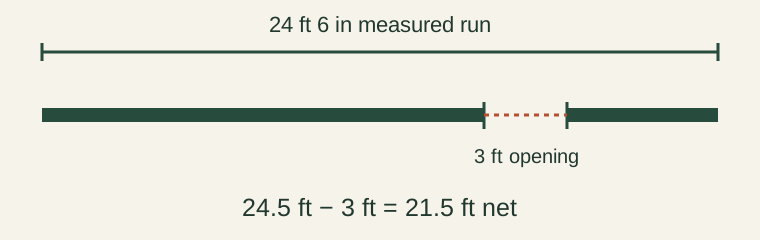
Deduct an opening only if the material stops there. A crossing that does not interrupt your edge is not automatically a deduction. Leave supplier allowances and product overlaps out of this measurement ledger, then check them separately.
Three runs, two openings, one checkable total
Worked example, not a measured project: A north bed edge is 24 ft 6 in with a 3 ft opening; a path edge is 18 ft 9 in with a 2 ft 6 in opening; a south bed edge is 12 ft 3 in without an opening.
- North bed edge: 24.5 − 3 = 21.5 ft net.
- Path edge: 18.75 − 2.5 = 16.25 ft net.
- South bed edge: 12.25 − 0 = 12.25 ft net.
The gross length is 55.5 ft. The openings remove 5.5 ft, leaving 50 linear ft, or 600 inches. The button in the tool loads exactly these inputs so you can inspect the arithmetic before replacing them with your measurements.
A correct total can still be a poor purchase plan. This worksheet does not choose stock lengths or arrange cuts. If a product overlaps at joins or uses special corner pieces, account for those using its instructions after you have checked the measured line.
Linear feet questions
How do I calculate linear feet from separate runs?
Convert each run to feet by adding feet + inches ÷ 12, then add the runs. Subtract only the openings where the measured line will have no material.
How do I enter a measurement such as 8 feet 9 inches?
Enter 8 in the feet field and 9 in the inches field. The calculator uses 8 + 9 ÷ 12 = 8.75 feet. Do not enter 8.9 feet for that measurement.
Can one run have more than one opening?
Yes. Add each opening beneath its own run. The worksheet shows their combined deduction and rejects openings whose total width exceeds that run.
Does net length tell me how many pieces to buy?
No. Net length measures the line that remains. It does not include waste, overlaps, corners, stock lengths or a cutting plan; confirm those separately for your product.
Can I turn square feet into linear feet here?
Yes, for a constant-width strip or roll. Enter its area and width in the separate converter: length = area ÷ width; area = length × width. This does not determine a bed’s boundary length or change the measured-run ledger.
Use the right measurement next
For quoted panelized fencing, take the checked net panel-run length to the fence calculator; enter gates separately and confirm the layout’s supports. For a bed, patio or lawn surface, use the square footage calculator with separately measured area dimensions. Length and area are different inputs, not interchangeable totals.