Panel fence calculator / Loose chain-link materials
Chain link fence calculator
Get fabric, post and top-rail counts from measured lines. Place each gate where it belongs; a shared corner is one terminal, not two.
Each uninterrupted span
Gates interrupt fabric and top rail. This ledger shows the separate post bays and whole-piece allocations behind the total.
Calculate a measured layout to see its spans.
A 100 ft line is not always one 100 ft span
A gate changes the counting. In the checkable example, an opening starts 40 ft from terminal A and is 4 ft wide. The two fenced spans are 40 ft and 56 ft, so fabric and rail planning length is 96 ft.
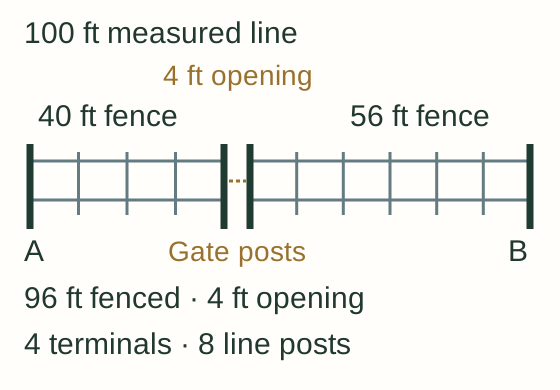
With a user-chosen 10 ft maximum spacing, the first span needs four bays and three line posts; the second needs six bays and five line posts. That is eight line posts and four distinct terminals. Spacing must come from the actual product and site plan.
With hypothetical 50 ft rolls and zero added fabric allowance, the pooled minimum is two rolls. Allocating new whole rolls separately gives one for 40 ft and two for 56 ft, or three rolls. At 21 ft usable rail coverage per piece, the separate allocation is two plus three, or five pieces. These sizes are example inputs, not shopping advice.
The formulas behind the ledger
- Net fenced length = total measured lines minus their opening intervals.
- For each fenced span: bays = round up (span length ÷ approved maximum spacing); line posts = bays minus one.
- Terminal posts = distinct named endpoints plus distinct interior opening boundaries.
- Planned fabric = each fenced span × (1 + fabric allowance ÷ 100).
- Pooled roll minimum = round up (all planned fabric ÷ one roll's length). Separate rolls = sum of each span's rounded roll count.
- Top-rail pieces = sum of each span's rounded usable-coverage count.
Sources and what stays outside the count
ProLink Supply's material guide distinguishes fabric minus gates, terminal posts, intervening line posts and rail footage. Master Halco's manufacturer instructions, hosted by Home Depot show terminal-to-terminal spacing, rail joining and fabric splicing. Both were checked on October 2, 2026; file-host dates do not prove a new installation standard.
Use the supplier's planned opening between gate posts, including its specified clearance, not the gate leaf width. Keep line lengths, opening positions and widths on the same measurement convention. Centre-to-face offsets, joint overlap, mesh adjustment, slopes and cut loss can change final fabrication lengths.
How tall is the fabric, and which mesh and coating match the order? Confirm those product choices separately. This tool does not select them, size posts, design gates or footings, count concrete or certify a structural layout. Tension bars, bands, caps, ties, sleeves, gate frames, hinges and latches are not included. No cost is implied by an unpriced count.
Chain-link takeoff questions
How do I subtract gates from a chain-link fence line?
Enter the whole measured line, then each opening's start distance and width. The calculator removes those intervals from fabric and rail footage and calculates the remaining fenced spans separately. Use the planned opening between gate posts, not the gate leaf width, and keep all measurements on the same convention.
How many line posts do I need?
For each uninterrupted fenced span, divide its length by your approved maximum spacing and round up to whole bays. Line posts equal bays minus one, because the two ends already have terminal posts. The tool does not select a structural spacing for your site or product.
How are shared corner and gate posts counted?
Use the same terminal label wherever two straight lines meet at one physical post. Labels are case-insensitive. The tool counts that named terminal once, adds terminals at interior gate boundaries and reuses a line-end terminal when an opening reaches the end. These counts do not specify post sizes or gate fittings.
Why are there two fabric roll counts?
The pooled count is a length-only minimum assuming compatible fabric can be joined and usable offcuts can move between spans. Separate allocation rounds whole rolls for each span without reusing its remainder elsewhere. Neither count is an optimized cutting plan; check mesh compatibility, joins and product allowances before ordering.
Is the top-rail result an exact cut list?
No. It rounds each fenced span by the usable coverage you enter for a rail piece. Account for your product's joints and end fittings when choosing that coverage. Gate rails, cut losses, sleeves and fittings are not counted, and offcuts are not reused across spans in this allocation.
Does this chain-link estimate include prices and every fitting?
No. It counts fabric footage and rolls, line posts, distinct terminal posts and top-rail pieces only. Prices, gate frames, concrete, tension bars, bands, caps, wire, sleeves, hinges and latches remain outside the takeoff. Obtain the actual product and installation list from your supplier.
Use the worksheet for the material you have
Buying panelized wood or vinyl? Keep that quote in the panel fence calculator. For a length-only measurement ledger, use the linear feet calculator. Calculate adjacent beds separately with the mulch calculator.