Mulch calculator / Mulch near a house
Mulch near structures · source-based guide
Does mulch attract termites?
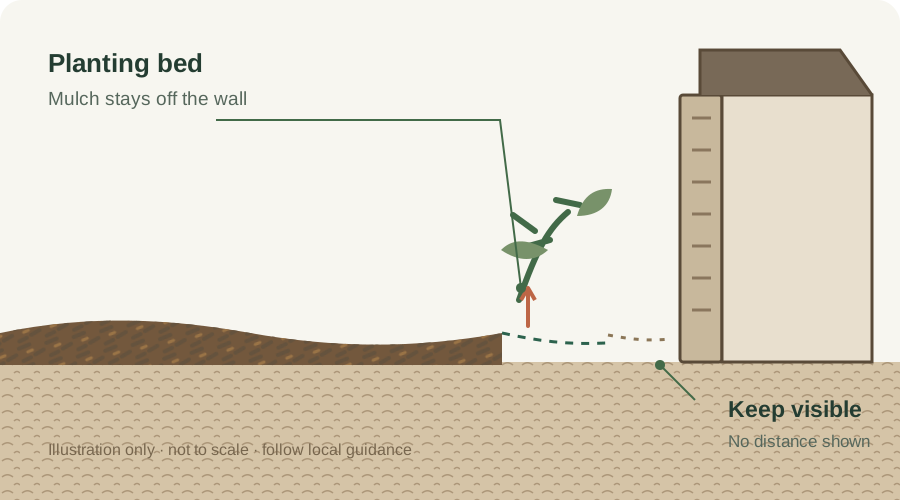
Mulch does not create a termite colony. Extension guidance differs on whether it “attracts” termites: Iowa State’s evidence did not show damp mulch drawing foragers from the surrounding landscape, while University of Kentucky Extension says moisture-retaining mulch can make an area more attractive. Both point to the same practical step: do not let mulch touch wood siding or hide the foundation inspection area, and use local guidance for any clearance distance.
What the guidance agrees on
- Moisture matters. Damp soil and the sheltered conditions under mulch can support termite activity where termites are already present.
- Mulch should not touch wood siding, door frames, or window frames. Keep the wall and the area you need to inspect visible.
- No mulch type is a proven termite barrier. Gravel can hold moisture too, and Iowa State’s field comparison found termites beneath gravel as well as several organic mulches and bare soil.
Why sources use different words for “attract”
Iowa State University Extension’s Iowa-focused article, dated May 4, 2001, says its review found no evidence that moisture draws termite foragers in from the surrounding landscape. It also reports that moisture favors exploration and feeding, and that termites may remain after they find suitable habitat. The article warns that it may not reflect the latest guidance.
University of Kentucky Extension describes moisture retention and insulation as features that can make mulch more attractive to termites. North Carolina State Extension also notes that moisture near a foundation favors termite problems. These sources describe site conditions and activity; they do not show that installing mulch creates a new colony.
So the useful distinction is between drawing termites from elsewhere and making a damp area easier for an existing colony to use. The research and wording vary by place and source. A mulch choice by itself cannot confirm or rule out termites.
Does switching from bark to gravel solve it?
No material should be treated as a termite shield. Iowa State’s field comparison reported similar detection under organic mulches, pea gravel, and uncovered soil, with sustained activity over time higher beneath gravel. Kentucky Extension notes that stone can retain moisture in the underlying soil. That evidence does not prove every material behaves the same at every home; it does rule out calling gravel “termite-proof.”
Choose a bed material for the planting and maintenance job it needs to do. Keep it away from wood, avoid trapping water against the structure, and leave enough of the wall visible to inspect. The clearance examples are not one standard: Iowa State’s 2001 article says to leave several inches, while Mississippi State suggests an approximately 2-foot mulch-free strip. Those are regional examples, not one nationwide clearance or a promise of protection. Follow current guidance for your building and location.
Before adding mulch beside a house
- Check the exact siding, trim, doors, and windows. Do not cover wood or bridge mulch up to wood components.
- Keep the foundation area visible and follow the current local or product-specific clearance guidance for your building. This page does not set a universal number.
- Check for water pooling or persistently damp soil beside the wall. Correct drainage or irrigation problems that keep the area wet.
- If you find mud tubes, swarmers, or damaged wood, arrange an inspection with a qualified local pest professional. A material calculator cannot identify an insect or assess an infestation.
Once you have chosen the bed layout and locally appropriate wall-side space, the foundation-bed mulch calculator can exclude the strip you enter before estimating material. The vertical-gap worksheet compares measurements with a target you provide. Both are arithmetic tools; neither chooses a safe clearance or assesses termites.
Mulch and termites: common questions
Does mulch cause termites?
Mulch does not create a colony. It can change moisture and shelter at the surface, and termites from an existing colony may forage in the area. Sources differ on whether that should be called “attracting” termites.
Should I remove all mulch from my yard?
Extension sources do not recommend avoiding all mulch. They advise using it with care near a structure, keeping it off wood, and following local guidance.
How far should mulch be from a foundation?
The distance in published guidance varies by location and building context. This guide intentionally does not turn regional examples into one universal measurement.
Can a mulch calculator tell me whether my house is at risk?
No. CoverCalc Pro calculates quantities from the measurements you enter. It cannot diagnose termites, inspect a building, or determine a safe clearance.
Sources
- Iowa State University Extension and Outreach: Does landscape mulch lead to termites in your home? — dated May 4, 2001; Iowa-focused discussion of termite foraging and a field comparison. The source itself cautions that its information may not be current.
- University of Kentucky Department of Entomology: Protecting your Home Against Termites — moisture near foundations, wood contact, and mulch use.
- Mississippi State University Extension: Common Questions about Termites and Termite Control — organic mulch near a home and a Mississippi regional example for a mulch-free strip.
- North Carolina State Extension: Termites—Preventing Problems in Existing Homes — moisture and keeping mulch away from the foundation and lowest siding.
Sources checked November 4, 2026. Extension recommendations vary by region and building; follow current guidance that applies to your location and materials.