Added depth
—
Target minus the existing settled layer
Mulch calculator / Top-up calculator
Existing layer + target depth
Measure the settled mulch already in the bed. This calculator subtracts it from your chosen finished depth, so the order covers only the additional layer.
The measurement that prevents over-ordering
If a bed already has a usable settled layer, entering the full target depth as new material counts that existing layer twice. The top-up calculation uses added depth = maximum of target depth minus existing depth, or zero. It then multiplies the added depth by the measured area.
Example: a 100 ft² bed with 1 inch already present and a 3-inch target needs a 2-inch addition. That is 16.67 ft³, or about 0.617 yd³, before an allowance. A 10% allowance makes 18.33 ft³, or about 0.679 yd³ and 10 whole 2 ft³ bags.
Use a site-specific target
There is no single depth for every bed. Iowa State University Extension says the effective range is generally 2 to 4 inches and that soil texture, climate, mulch type, plant age, and the purpose of the mulch all matter. Its guidance places coarse material toward the higher end and fine material toward the lower end.
Oregon State University Extension says to determine the existing depth before reapplying bark or wood chips. Its woody-landscape guidance says bark should not exceed 3 inches and wood chips should not exceed 4 inches. These are extension examples for particular materials and plantings, not automatic settings in this calculator.
For tree rings, several extension sources also warn against piling mulch against the trunk. Measure the area and layer while leaving the trunk flare exposed according to appropriate local guidance.
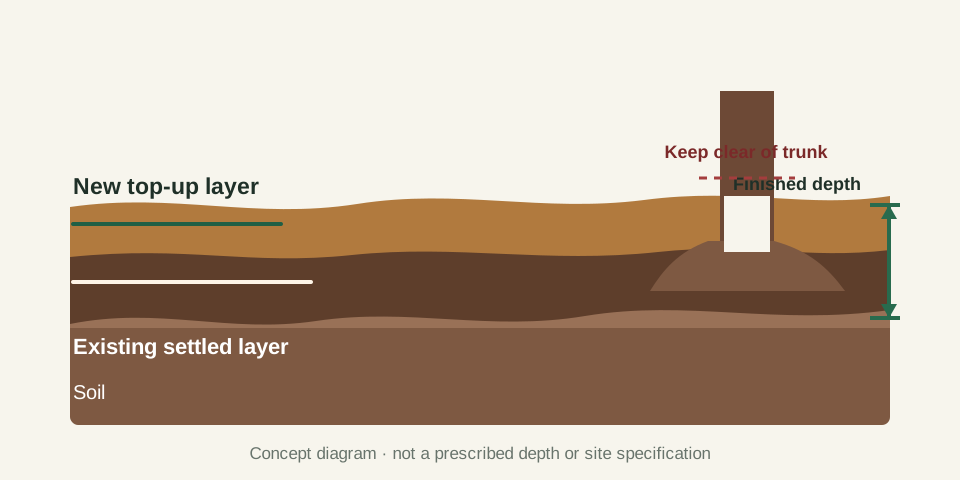
Before entering a number
This calculator does not decide whether old material is usable, compacted, contaminated, or due for removal. Inspect the bed before treating the measured layer as reusable depth.
Transparent calculation
Maximum of target finished depth − existing settled depth, or zero.
Area × added depth after converting inches to feet or centimeters to meters.
Exact volume × (1 + allowance ÷ 100). The allowance is shown separately.
Planning volume ÷ printed bag volume, rounded up to the next whole bag.
Common questions
The calculated addition is zero. The result does not tell you whether to remove or reuse material; inspect the condition, trunk clearance, drainage, and plant setting before deciding.
Use measurements that represent the area being calculated. If depths differ substantially, divide the bed into sections rather than hiding the variation in one input.
No. It is applied after the geometric volume calculation and remains visible as a separate planning choice.
Yes. The mulch refresh by bed calculator takes each bed's measured existing and target depth, then combines only the new material into one bag or bulk order. For one combined known area measured in m² and millimetres, the metric mulch calculator gives m³, litres and whole bags.