Mulch calculator / Mulch lifespan
Mulch care · material life
How long does mulch last?
Mulch has no universal lifespan. UC Marin says leaves and clippings break down quickly, bark and pine needles typically last around 2–4 years there, and gravel or pebbles rarely need replenishing. The range is regional, not a guarantee.
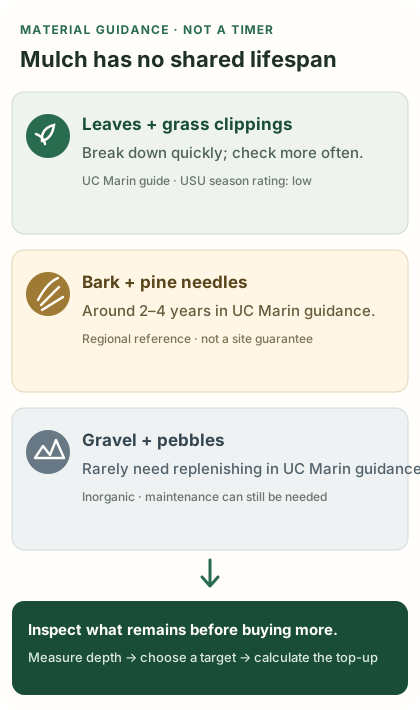
What extension guidance says about each material
Leaves and grass clippings
These break down quickly and need frequent replenishment in the UC Marin guide. Utah State University Extension also rates leaves and lawn clippings low for lasting one full season in its qualitative material table. Neither source sets one annual schedule for every bed.
Bark and pine needles
The UC Marin guide gives a typical range of around 2–4 years. It is a useful local reference, not a product warranty or a universal service life. Utah State Extension's separate table rates bark highly for lasting one full season, but does not give a multi-year interval.
Wood chips
Wood chips are organic and gradually decompose. Utah State Extension rates them highly for lasting one full season, which is a qualitative comparison rather than a claim that every bed needs a yearly replacement.
Gravel and pebbles
UC Marin describes these inorganic materials as rarely needing replenishment; Utah State Extension says inorganic mulches last longer than organic materials. That does not mean they never need site maintenance.
Why the calendar is only a rough guide
Organic mulch breaks down and becomes part of the soil. Utah State Extension notes that larger mulch particles—usually larger than about ½ inch—slow decomposition in its water-wise landscaping guidance. Material type and particle size therefore change how quickly a layer changes; the published references above also use different locations and comparison methods.
These sources describe material behavior, not a fixed replacement interval. The practical question is how much suitable mulch remains at the bed, compared with a depth chosen for that material, planting, and local guidance.
Measure what remains before buying more
- Check several representative spots and record the settled layer. If it varies, keep the thin and deep sections separate instead of hiding them in one average.
- Choose a suitable finished depth for the material and planting using local extension guidance. A lifespan estimate does not choose that depth.
- If a top-up is appropriate, compare the target with the measured layer. Utah State Extension describes adding new organic mulch over decomposed material and roughening the old surface first to reduce the chance of a water-impervious boundary.
Calculate only the mulch missing from each bed using your measured existing depth and chosen target. The calculator does not set an annual refresh schedule. For a cost projection over a period you choose, use the mulch vs. gravel lifecycle cost calculator; it leaves refresh timing and costs to your inputs.
Sources
- UC Marin Master Gardeners: Applying Mulch — material-specific replenishment descriptions and the regional 2–4 year bark and pine-needle reference.
- Utah State University Extension: Using Mulches in Utah Landscapes and Gardens — a qualitative “lasts one full season” table and guidance to maintain organic layers as they decompose.
- Utah State University Extension: Water-Wise Landscaping: Mulch — decomposition, particle-size guidance, and adding new organic mulch over decomposed material.
- University of Maryland Extension: Excess Mulch Problems — organic mulch should be replenished as needed to maintain its original depth.
Sources checked November 3, 2026. Extension guidance varies by location and material; follow current local recommendations for the planting you are maintaining.