Hydromulch Water & Load Calculator
Use measured area, a project rate, the fiber-to-water pair in your mix instructions, and two separate per-load limits. Get total dry fiber, carrier water and a final partial-load ticket—without guessed rates or machine presets.
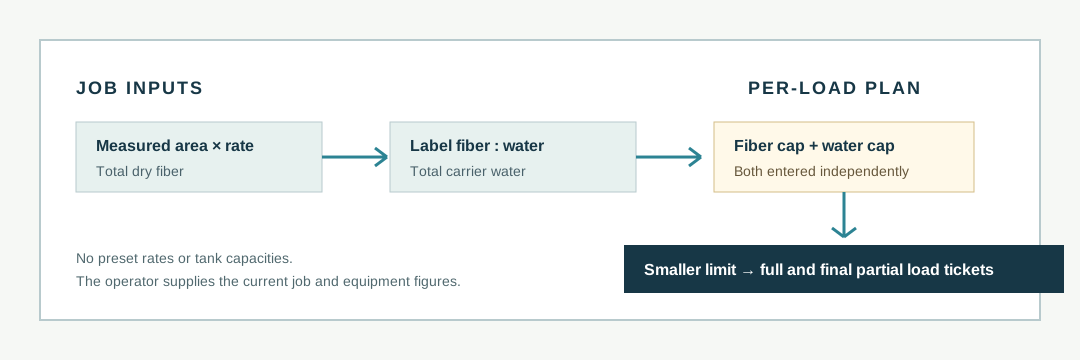
How the calculator reaches each load ticket
First, it converts your entered area and application rate into total dry fiber. It then scales the paired fiber and water quantities from your mix instructions to calculate total carrier water. For each load, the calculator converts the entered water limit into an equivalent fiber amount and compares that with the separate fiber limit. The smaller value sets the arithmetic batch size.
Fiber per unit of water = entered label fiber ÷ paired label water
Total carrier water = total dry fiber ÷ fiber per unit of water
Fiber per load = smaller of entered fiber limit and (entered water limit × fiber per unit of water)
Load count = round up (total dry fiber ÷ fiber per load)
Calculations use exact decimal inputs before display rounding. The final ticket is calculated from the amount left after full loads; it can be smaller than the entered limits.
Worked arithmetic example
NC State Extension publishes a sample calculation using 40 lb of hydromulch per 100 US gallons of water and an application rate of 3,000 lb per acre. For a hypothetical half-acre, those example inputs produce 1,500 lb of fiber and 3,750 US gallons of carrier water. The source presents this as an example, not a universal rate or recipe.
For arithmetic only, suppose the entered per-load plan allows 1,000 lb of fiber and 1,000 US gallons of water. At 40 lb per 100 gallons, that water amount pairs with 400 lb of fiber. The water limit is smaller, so the tickets are:
| Ticket | Dry fiber | Carrier water |
|---|---|---|
| Load 1 | 400 lb | 1,000 US gal |
| Load 2 | 400 lb | 1,000 US gal |
| Load 3 | 400 lb | 1,000 US gal |
| Load 4 · partial | 300 lb | 750 US gal |
| Total | 1,500 lb | 3,750 US gal |
The half-acre is a worked arithmetic input. The per-load limits above are hypothetical, not an equipment specification. Do not treat this example as a material selection, application recommendation, recipe or safe-fill instruction.
Why fiber and water stay separate
Hydromulch is applied as a water-carried fiber mixture, but the water amount and dry-material amount answer different planning questions. NC State Extension explains that water needs depend on the manufacturer's recommended amount of material in the tank and the recommended application rate. Its sample scales an entered mix amount against an area rate.
Caltrans notes that fiber application rates vary with fiber material, slope roughness, slope steepness and seed type. That is why this page starts blank and asks for the rate that applies to the actual job. It does not infer a rate from a slope or suggest that one product's figures apply to another.
Equipment figures also need context. For example, FINN's T330 specification lists fiber-mulch material capacity separately from the machine's working and liquid capacities. This calculator does not copy those values into the form or convert a tank rating into a usable water allowance. Enter per-load amounts only after checking the current equipment and product instructions for the specific plan.
What to have before calculating
- A measured job area in one of the listed area units.
- The application rate from the current project specification or product instructions.
- A paired fiber and water amount from the exact current mixing directions.
- Separate usable fiber and water limits for one planned load, confirmed for the equipment, mix and operating plan.
If any input is unknown, leave it unresolved and check the applicable source; this calculator will not fill gaps with a generic average. Nominal tank capacity alone does not establish an allowed water volume per batch.
Hydromulch calculation questions
What inputs does this hydromulch load calculator need?
Enter the measured project area, the application rate from your current project plan or product instructions, a paired fiber-and-water amount from the current mix instructions, and separate usable fiber and water limits for one planned load. The calculator uses no product, rate or equipment presets.
How is water calculated from a fiber-to-water label pair?
The calculator divides the entered fiber amount by its paired water amount to get a fiber-per-water ratio. It multiplies the required dry fiber by the inverse ratio to calculate carrier water. This scales your entered pair; it does not choose or approve a mix.
Does the page recommend an application rate or hydromulch recipe?
No. Enter a rate and mix pair from the current project specification, product instructions or operating plan that applies to your job. The calculator does not select a material, judge site conditions or recommend an application rate or recipe.
Can I use a machine's tank size as the water limit per load?
Not automatically. Enter only a usable per-load water amount confirmed for your equipment and mix. A tank's nominal or working capacity is not automatically the amount of carrier water allowed in one batch; this calculator does not determine fill level, headspace or machine limits.
Why can water limit the fiber amount even when fiber capacity is higher?
The entered mix pair implies how much water corresponds to a given dry-fiber amount. The calculator converts your entered water limit into its equivalent fiber amount and compares that with the separate fiber limit. The smaller entered constraint governs the arithmetic load count.
Sources and boundaries
- NC State Extension, “Mulch Options for Erosion Control on Construction Sites” (published May 20, 2019; reviewed March 13, 2024): source for the displayed example quantities and the boundary that application and water figures depend on the project and manufacturer guidance.
- Caltrans, “Erosion Control Toolbox: Fiber” (updated February 19, 2019): source for the statement that fiber application rates vary by material and site factors.
- FINN, T330 & T400 HydroSeeders specifications (accessed October 12, 2026): an example of a manufacturer listing fiber-material capacity separately from working and liquid capacity.
This is a quantity worksheet, not erosion-control design, product selection, an operating procedure, a machine-capacity reference or a safe-fill calculator. Confirm job-specific rates, mix directions and usable load limits with the current governing documents and responsible equipment operator.