Mulch calculator / Bed preparation / Soil to move
Mulch-bed edge soil calculator
Compare soil moved at just the edge with a whole-bed cut. An idealized straight taper uses length × strip width × deepest cut ÷ 2.
Example: 120 ft × 6 in × 3 in taper = 7.5 cu ft of in-place soil.
Soil to move
In-place geometry— cubic yards
Measure the edge length, strip width and deepest cut to see your soil volume.
Illustrative values are loaded. Replace every number before using this result for your site.
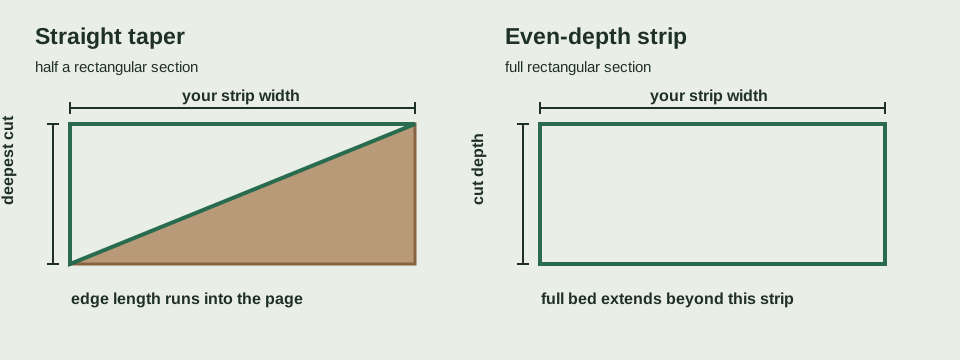
What the two numbers mean
For a straight taper, convert width and depth from inches to feet, multiply by the measured edge length, then divide by two. For an even-depth strip, use the same multiplication without dividing by two. The whole-bed comparison is bed area in square feet multiplied by an even cut depth in feet. One cubic yard is 27 cubic feet.
For example, a 120 ft edge with a 6 in inward strip and a 3 in deepest cut gives 7.5 cu ft (0.28 cu yd) as a straight triangular taper. A separately measured 400 sq ft bed lowered evenly by 3 in gives 100 cu ft. The 92.5 cu ft difference compares idealized in-place shapes; it does not predict time, loose pile size, weight or disposal charges.
Colorado State University Extension’s mulching guidance describes both lowering a whole bed and rounding down soil only near its edge. It also cautions that a lowered bed must not collect water draining from higher ground. The diagrams there inspired the question, not this page’s artwork or a fixed trench dimension. The straight taper here is a transparent mathematical approximation, not a universal installation instruction.
Keep soil removal separate from the mulch order
After deciding the finished grade, measure the area that will actually receive mulch. Iowa State University Extension describes area × planned mulch depth for material volume. Use our mulch quantity calculator for that separate order, or the edging roll cut planner if you are buying a cuttable border product. Neither tool should use removed soil volume as mulch volume.
This worksheet cannot tell you whether to dig around tree roots, buried utilities, irrigation, a foundation or a drainage path. It does not set a recommended depth or replace a site-specific plan.
Questions before digging
How much soil would I remove to lower only a mulch-bed edge?
Measure the edge length, the width of the strip being lowered and its deepest cut. For an idealized straight taper, multiply those three measurements and divide by two. A rounded edge will differ, so treat this as an in-place geometric estimate, not loose disposal volume.
Is lowering only the edge always better than lowering the whole bed?
No. The two volumes describe different shapes of work, not which grade is suitable. Check how water moves across your site before choosing; this calculator cannot assess drainage, roots, utilities or the finished mulch surface.
Does this result tell me how much mulch to order?
No. Removed soil and new mulch are separate quantities. After choosing a finished bed shape, measure the area and planned mulch depth in the mulch calculator to estimate material volume.