Mulch Edging Roll Cut Calculator
Measure the mulch area and each uninterrupted border run. See whole-bag quantity and a minimum roll-by-roll cut plan.
Your material ticket
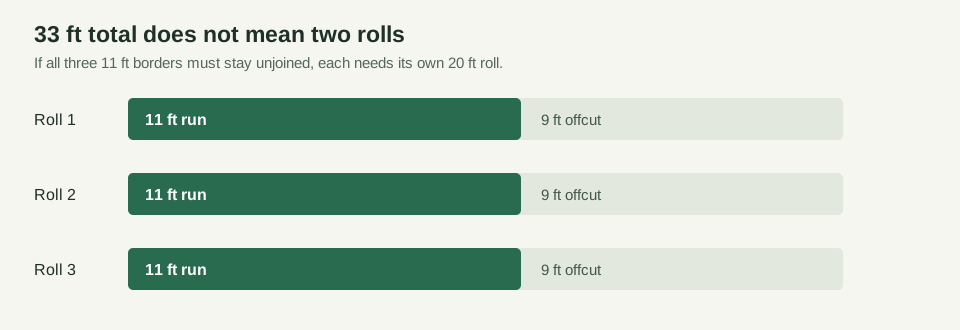
Worked example: three separate 11 ft runs on 20 ft rolls need 3 rolls, not the 2-roll total-length lower bound. Enter your measurements for a project-specific plan.
Cut each roll
The cut ticket appears after you enter all measurements.
Preparing a lowered natural bed edge before buying edging? The measured soil-removal comparison estimates the edge-strip cut separately from a whole-bed cut. It does not change this product roll plan.
How this worksheet counts
Mulch cubic feet = measured square feet × entered depth in inches ÷ 12. Cubic yards = cubic feet ÷ 27. Whole bags = cubic feet ÷ the bag's printed cubic-foot volume, rounded up once. If your area already includes a waste allowance, do not add it again here.
For rectangles, the optional helper adds each non-overlapping length × width area and the lengths of only the sides you select. It can subtract one measured unmulched area from the mulch total, but it does not detect overlapping rectangles, shared borders, openings or curved outlines. Use the direct measured-area and edge-run fields for other footprints, or divide an irregular bed into non-overlapping rectangles before using the helper.
The cut plan tries every valid assignment of up to eight measured edge runs and returns the fewest whole rolls when each run must come from one continuous piece. The simple “total length ÷ roll length” count is shown only as a lower bound; it can be too low when offcuts cannot fit another entire run. This is a mathematical no-join layout, not a product guarantee. Check the instructions for the exact product's cut limits, joints, overlap and fastening before buying. The worksheet does not infer product compatibility or installation rules.
Enter a depth suitable for your material and site; this is quantity arithmetic, not a planting or drainage recommendation. For organic mulch near plants, review local guidance such as the University of Maryland Extension's tree and shrub guidance. This worksheet does not calculate product price, taxes, shipping, spike count or joint pieces.
Before you buy
Why can I need more rolls than total feet divided by roll size?
Each run in this worksheet must be one unjoined piece. A short offcut cannot finish a longer run without a joint, so the purchase can exceed the total-length lower bound.
Can I use this for a product that joins pieces?
Not as a final jointed installation plan. The roll count here assumes no joint inside a measured run. Use the product's approved connector and overlap instructions to plan a joined installation separately.
Does an edging run have to match the mulch area boundary?
No. Enter the total area receiving mulch and only the individual border lengths where you intend to install this product. A wall, path or existing hard edge may need no new edging.
Can I derive mulch area and edging runs from rectangular beds?
Yes. Enter separate, non-overlapping rectangle measurements, then select only the individual boundaries that need the edging product. The helper adds the rectangle areas and selected side lengths. For curved or irregular outlines, use the direct area and measured-run fields.