Mulch calculator / Cover an existing pile
Mulch Pile Cover Size Calculator
The pile is already on the ground. Measure over it—not its flat footprint—to size a top cover. This checks dimensions, not whether you need a tarp.
Field measurement ticket
Minimum finished cover
Worked example — replace the sample measurements below.
12 ft over the length + 1 ft on each end; 9 ft over the width + 1 ft on each side.
Use measured drape distances, not cubic yards or the flat footprint. Confirm the product's finished dimensions and keep organic mulch ventilated according to your supplier's instructions.
Measure the pile, then the cover
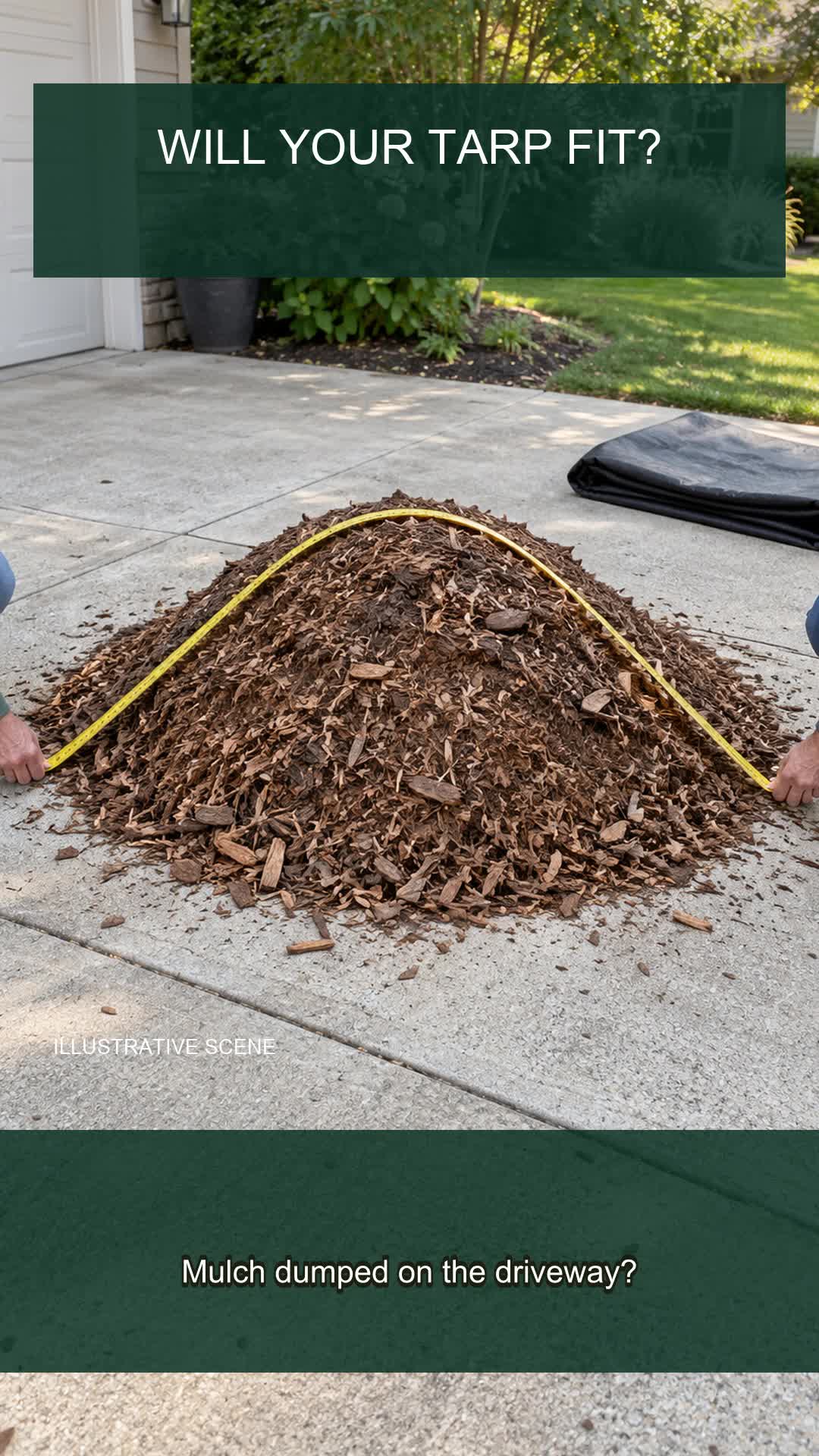
Use a flexible tape from ground level, across the top, back to ground level. Measure again at right angles. A straight line along the driveway is not the drape length.

See the tape go over the pile
Our 27-second English video shows the ground-to-ground measurement, then checks a finished tarp in the live calculator.
- Measure over the pile in both directions.
- Add your chosen extra edge on each side.
- Check the finished cover dimensions in both orientations.
Read the worked example
The example uses 12 ft over the length and 9 ft over the width. Adding 1 ft at each end and side gives a minimum finished cover of 14 × 11 ft. A 12 × 16 ft finished tarp fits when rotated. These are example inputs, not measurements taken from the video image or a recommended edge allowance.
The measuring scene is AI-generated and illustrative, not a customer project. The video also uses stock garden footage and our real calculator. This page loads no YouTube player; the link opens YouTube in a new tab.
 Watch on YouTube
What the numbers mean
Minimum finished length = measured over-pile length + twice your chosen end edge. Minimum finished width = measured over-pile width + twice your chosen side edge. The calculator tests your existing cover as entered and rotated. If neither fits, it reports the shortfall on both axes in the orientation with the smaller combined deficit. A numeric fit only means that the dimensions you entered fit; it does not prove wind resistance, material suitability or safe storage.
Do not estimate these drape distances from the load's cubic-yard volume. Different dump shapes can hold the same volume. If the pile changes as you use it, remeasure before buying a different cover. Keep the tarp's edges and anchors clear of access routes and ask your supplier how to secure and ventilate the material.
Covering is conditional
Sackora's stockpile-cover product guidance describes fabric draped past a pile's base with enough material for weighting or anchoring, and distinguishes breathable covering for organic material. Greener Horizon's storage guidance describes a raised cover arrangement that allows airflow for stored mulch. Neither source supplies a universal edge length for a homeowner's pile. Follow your material supplier's current instructions, especially if the pile will sit for more than a short project window.
Need to plan the ground tarp before the truck arrives? Use the mulch delivery space calculator. Need to estimate the amount of mulch in an existing mound instead? Use the mulch pile volume calculator; that volume still cannot determine a top-cover shape.
Quick checks
Can I choose a top cover from cubic yards alone?
No. Cubic yards describe volume, not the mound's drape length or width. Measure over the actual pile in two directions and add only the edge allowance you choose.
Does a tarp fit if its labeled size matches the result?
Only if those are the cover's usable finished dimensions. Enter that finished length and width to check both orientations, then confirm material and anchoring instructions separately.
Should I seal an organic mulch pile under a tarp?
Do not infer that from this size result. Supplier guidance for organic stockpiles emphasizes airflow; follow the material and cover instructions rather than sealing a pile because a numeric fit says “yes.”