Mulch calculator / Delivered pile
Mulch Pile Volume Calculator
Estimate a loose pile from measured cross-sections instead of assuming one smooth shape. Record the same five points across each section, then compare sections along the pile.
Go to field measurementsWorked example
2.67cu yd
72 cubic feet
Worked example: cross-section areas of 10 and 14 sq ft, measured 6 ft apart.
Example only. Enter your measured sections below to calculate your pile.
Rough geometry estimate only—not a supplier delivery, invoice, or shortage check.
Optional: compare with a ticket quantity
Enter or edit your own pile measurements to enable this comparison.
Rough estimated difference (pile estimate − ticket quantity): — cu yd
A positive result means the rough estimate is higher than the entered ticket quantity; a negative result means it is lower. This arithmetic is not proof of the amount supplied or billed. NIST lists 27 cubic feet in 1 cubic yard in its unit table.
Checking a pre-order quote is a separate task: use the Mulch Quote Check Calculator with the measured bed and written quote. It does not transfer pile measurements or audit an already delivered load.
How the total adds up
| Section or interval | Distance / type | Area / volume |
|---|
Enter field measurements
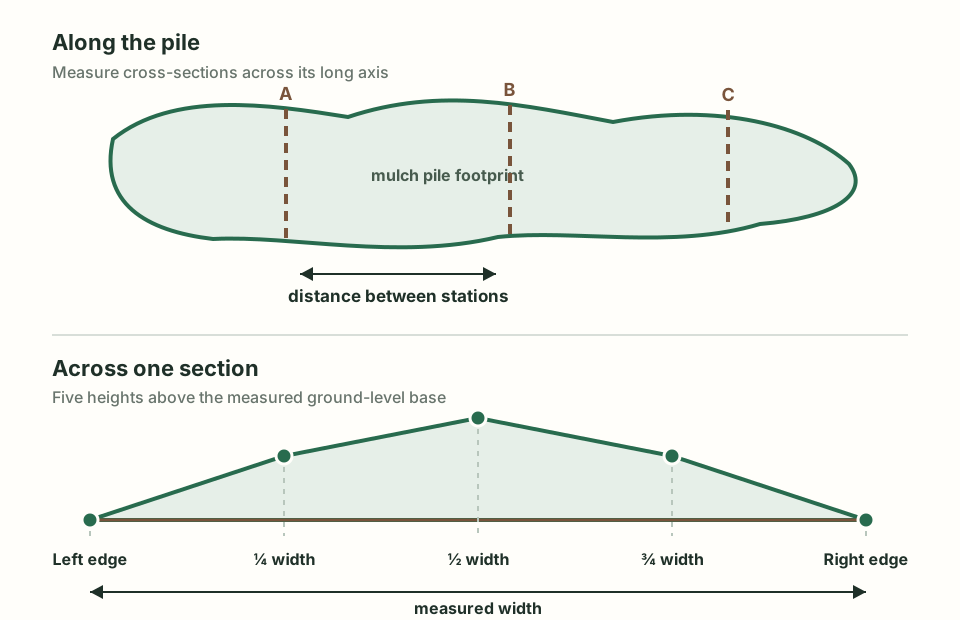
Lay out cross-sections at right angles to the pile's long axis. At each section, record its ground-level width and five heights at the marked positions. Enter the distance from one section to the next. The form starts blank; the example above is not your pile.
Measure only from stable ground. Do not climb or stand on a loose pile. If a safe measurement is not possible, stop and use a qualified surveyor or the supplier's documented method. Removing a middle section combines the two adjacent spacing measurements; recheck the displayed distance before using the result.
How the estimate works
At each station, the calculator joins the five equally spaced height readings with straight lines and adds the four trapezoid areas. Between neighboring stations, it averages their area estimates and multiplies by the entered distance. It sums the segment volumes in cubic feet and divides by 27 to convert to cubic yards.
The worked example uses 10- and 14-sq-ft section areas 6 ft apart. The estimated interval is 72 cu ft, or 2.67 cu yd. A total includes only the measured distance between the first and last sections; it does not add volume beyond those endpoints.
Use the result as a rough estimate
More sections can capture changes that one length × width × peak-height model cannot describe, but this worksheet is still an approximation—not a survey. Add stations where width or height changes quickly; a long gap can hide a ridge, hollow, or sudden change. No section count guarantees an accuracy range.
Measure height above the pile's actual base. This calculator cannot correct an uneven or hidden base, overlapping piles, walls, hollows, settling material, or mulch mixed into the ground. It does not determine weight, density, compaction, sales quantity, contract terms, or whether a delivery was short. For a billing question, use the supplier's documented method and delivery records.
The University of Georgia instructional stockpile example shows how multiple measured sections can support a rough estimate and why extra readings may help describe an irregular shape. It is educational geometry material, not a retail mulch delivery standard. For a pre-order quantity from a garden bed, use the mulch coverage calculator instead.
Questions about measuring a pile
How many cross-sections should I measure?
The calculator can estimate between two sections, but three or more give you more checkpoints along the pile. Add sections where the pile changes width or height quickly. No section count guarantees survey accuracy.
How does the calculator turn sections into cubic yards?
It estimates each cross-section with trapezoids between five evenly spaced height readings. Between adjacent sections, it averages their estimated areas and multiplies by the measured distance. It adds those segment volumes in cubic feet, then divides by 27 cubic feet per cubic yard. The result is an approximation.
Does comparing this estimate with a ticket prove a delivery shortage?
No. The optional comparison subtracts the ticket quantity you enter from this rough geometric estimate. It does not verify a supplier's loading records, scale ticket, invoice, material density, compaction, or any contractual tolerance, and a difference alone does not prove how much was supplied or billed. Use the supplier's documented measurement method for a billing question.
Can I use it on uneven ground or a merged pile?
Only enter heights measured above the pile's actual base. This worksheet cannot correct for an uneven or hidden base, overlapping piles, hollows, walls, or material mixed with the ground. Use a qualified survey or another documented method when those conditions matter.