Mulch calculator / Tree rings
Tree Mulch Ring Calculator
Choose a top-up or ring expansion. Measure each tree separately and order only the new mulch the measurements call for.
New mulch to add
—cu ft
— cubic yards — whole bags
Enter one tree's measurements below. No tree dimensions or bag size are assumed.
Measure each tree
Use actual measurements. Add a separate row when the ring or existing layer differs.
Tree-by-tree worksheet
- Complete a tree row to see its added volume.
Inner and outer boundary lengths are optional geometry measurements, not an edging recommendation or roll count. Choose only the edges you need; the copied summary includes these lengths. For compatible, uninterrupted runs that fit one roll, continue to the mulch edging roll-cut worksheet. It does not infer joints, overlaps or product-specific installation rules.
What the result counts
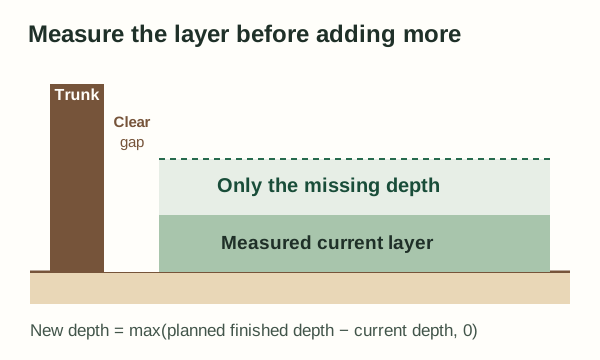
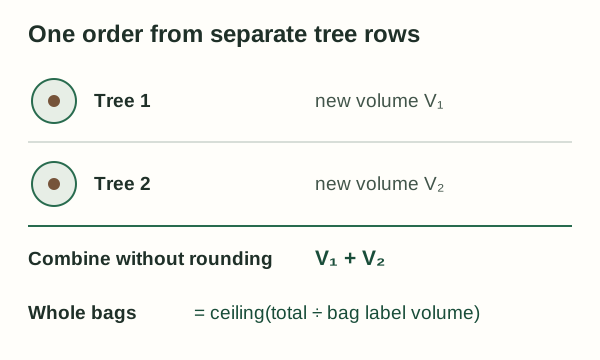
Top-up mode subtracts the trunk radius plus your bark-clear gap from the measured outer circle, then multiplies that ring area by the positive difference between target depth and the layer already present. Expansion mode calculates the band between two measured outside diameters and applies only the missing depth in that band. Both modes sum new volume across trees before rounding a bag order up once.
Top-up area = π × (outer radius² − inner radius²)
Expansion band area = π ÷ 4 × (planned outside diameter² − current outside diameter²)
New volume = area × max(target depth − current depth, 0) ÷ 12
Diameters and radii are in feet; trunk diameter, bark gap and depths are in inches. One cubic yard is 27 cubic feet. Expansion mode assumes the two outside circles share a center and estimates the full band between them. These are geometric quantities, not a guarantee of uniform depth, material compaction, package volume or a delivery quote.
An Ask Extension question describes measuring a tree ring at about 3 ft and considering a 6-ft outside diameter. Those are scenario measurements, not a recommendation for another tree. Expansion mode lets you enter the dimensions and depth that fit your site.
Two different trees, one order. As an arithmetic example, a 10-ft outer ring around a 12-in trunk with a 6-in bark gap needs about 12.566 cu ft when an existing 1-in layer is brought to 3 in. A second 6-ft ring around a 24-in trunk with a 3-in gap needs about 1.947 cu ft when its existing 2-in layer is brought to 3 in. Add the unrounded amounts: the order is 14.51 cu ft, or 8 whole bags if the bag label says 2 cu ft. These measurements and bag volume illustrate the math; they are not a recommended tree layout or supplier specification.
Keep the trunk visible
University of Maryland Extension's tree-mulching guidance says mulch should not touch bark, advises a shallow one-to-three-inch layer and about three inches of separation from a tree trunk, and suggests extending outward beneath branches where possible. Its excess-mulch guidance says organic mulches should be replaced only as needed to maintain their depth, rather than continually adding material. A K-State Extension article updated August 25, 2026 describes a 6–12 in bare-center diameter and a 2–4 in mulch layer, ideally extending toward the drip line. These are source-specific references, not universal dimensions or calculator defaults. If a local source gives the full bare-center diameter, the FAQ below explains how to translate it to this worksheet's bark-gap input. Check the tree, site and local professional plan before spreading material.
Tree ring questions
Is the clear gap measured from the bark or the tree center?
Enter the gap measured outward from the bark. The calculator adds half the measured trunk diameter before subtracting the unmulched center from the outer circle.
How do I convert a bare-center circle diameter to the bark-gap input?
Subtract the measured trunk diameter from the bare-center circle diameter, then divide by two. For example, a 12 in bare-center circle around a 6 in trunk leaves a 3 in gap from bark. Enter that gap, not the full bare-center diameter. Use this only when both measurements refer to the same centered circle, and follow tree-care guidance appropriate to your site.
Should I add a full new layer over mulch already in place?
Measure the current layer and enter your intended finished depth. This worksheet calculates only the positive difference. If the current layer already meets or exceeds your target, it returns zero new material for that tree.
How does expansion mode count a wider ring?
Enter the current and planned outside diameters. The calculator estimates only the band between those circles, then applies the positive depth difference you enter for that added band. It does not choose a tree size or mulch depth.
Does this tool choose a safe tree-mulch depth for me?
No. Enter measurements and a finished depth appropriate to your tree and site. University of Maryland Extension advises a shallow one-to-three-inch layer and keeping mulch about three inches away from tree trunks; check local guidance before applying it.
Planning another shape?
The main mulch calculator handles rectangles, circles, triangles and measured areas. This worksheet handles tree-ring top-ups and outside-diameter expansions.