Mulch calculator / Playground surfacing
MEASURED AREA · SOURCE-LINKED DEPTHS
Playground Mulch & Loose-Fill Quantity Calculator
Compare the loose-fill depth references in CPSC Table 2, then estimate initial material volume for an area you have already measured.
Public-playground planning reference. This page calculates quantities only. It does not choose a material, size an equipment use zone, rate a product, or check safety or compliance. Use current product-specific test and installation documents when available.
YOUR MEASUREMENTS · YOUR PRODUCT LABEL
Estimate the fill order
Enter the full surfacing area from your own layout. Choose a table row only after confirming the planned material.
CALCULATED FROM YOUR INPUTS
Quantity estimate
Choose a material to see its listed depths.
A depth-table reference is not a product test result. The calculation does not tell you whether a material or installed surface is suitable for the equipment.
SOURCE TABLE · PUBLIC PLAYGROUND GUIDANCE
CPSC Table 2 loose-fill references
The July 2025 handbook presents these fallback depths for non-impact-tested loose-fill materials when tested material data with a manufacturer-specified critical height are unavailable. The figures below are references from that table, not a calculator-selected recommendation.
| Loose-fill material | Installed depth | Compressed depth | Listed critical height | Initial volume for your area |
|---|---|---|---|---|
| Rubber mulch | 8 in | 6 in | 10 ft | Enter area |
| Sand | 12 in | 9 in | 4 ft | Enter area |
| Pea gravel | 12 in | 9 in | 5 ft | Enter area |
| Wood mulch (non-CCA) | 12 in | 9 in | 7 ft | Enter area |
| Wood chips | 12 in | 9 in | 10 ft | Enter area |
The handbook notes that rubber loose-fill does not compress in the same way as other loose-fill material, though displacement can still occur. Conditions and maintenance can reduce a listed critical height. Read the source table and the current instructions for the exact product.
Read the CPSC Public Playground Safety Handbook · Publication 325, July 2025, §2.4.2.2 and Table 2.
CHECK THE ORDER MATH
Area × depth gives the volume
For a square-foot area and an inch depth, divide the product by 12 to get cubic feet. Divide cubic feet by 27 to get cubic yards.
- Initial fill: area (ft²) × installed depth (in) ÷ 12 = ft³.
- Table comparison: area × compressed depth ÷ 12 = ft³ at the listed compressed depth.
- Quantity difference: area × the positive difference between the table depth and your measured current depth ÷ 12.
- Whole bags: round up initial ft³ ÷ the package volume you enter.
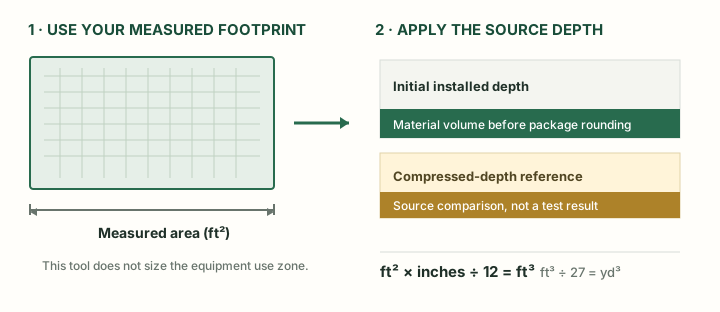
Worked example with chosen inputs
For 200 ft² and the wood-chips row, 12 in installed depth gives 200 × 12 ÷ 12 = 200 ft³, or 200 ÷ 27 = 7.41 yd³. At a label volume of 2 ft³ per bag, that is 100 bags before any supplier-specific order rule.
If the current average measured depth is 7 in, the difference to the table's 9 in compressed-depth reference is 200 × (9 − 7) ÷ 12 = 33.33 ft³. This is a volume difference, not a performance or safety finding.
KEEP THE REFERENCE IN SCOPE
What this calculator does not decide
- Product-specific data come first. If the manufacturer provides impact-test and installation information for the exact surfacing product, use those documents rather than substituting this fallback table.
- The measured area is yours. Enter the full planned surfacing footprint from a separately determined layout. The calculator does not size use zones around swings, slides, or other equipment.
- The table is not a pass/fail test. It does not compare equipment fall height with a product's tested critical-height rating, inspect the installation, or determine local requirements.
- Keep the use context in view. CPSC Publication 325 is the Public Playground Safety Handbook. For home play equipment, follow the equipment and surfacing manufacturer's current instructions; this page does not assess a residential installation.
COMMON QUESTIONS
Playground mulch calculator FAQ
How much playground mulch do I need?
Enter the full measured surfacing area, choose a CPSC Table 2 material row, and use its listed installed depth to estimate cubic feet and cubic yards. Enter the package volume from the product label if you also need a whole-bag count.
Does this calculator choose a safe depth?
No. It displays source-linked table values and calculates material quantity. Use the exact product's current impact-test and installation documents; this page does not decide whether a surface is suitable for equipment.
What does the compressed-depth value mean?
It is the compressed-depth figure listed beside the installed depth in CPSC Table 2. The handbook says loose-fill materials change with use and weather and need maintenance; this calculator does not inspect or certify the installed depth.
Can I use the calculator to measure the fall zone?
No. Enter the full surfacing area from a layout you have already measured. This calculator does not determine equipment use zones or their dimensions.
How many bags should I buy?
Enter the package volume in cubic feet from the bag label. The calculator divides the estimated initial volume by that amount and rounds up to a whole bag. It does not assume a standard bag size.
Is ordinary garden mulch interchangeable with playground surfacing?
This calculator cannot determine product suitability. Check the exact product's impact-test, installation, and maintenance information for the intended play use.
PRIMARY SOURCES
References and calculation basis
- U.S. Consumer Product Safety Commission, Public Playground Safety Handbook, Publication 325, July 2025 — §2.4.2.2 and Table 2 provide the loose-fill depth references used above. CPSC says Table 2 applies when impact-tested material data with a manufacturer-specified critical height are unavailable. Checked October 11, 2026.
- NIST Handbook 44 (2026), Appendix C — unit conversion reference: 27 cubic feet equal 1 cubic yard.