Mulch calculator / Mulch timing
Mulch planning · timing
When should you mulch?
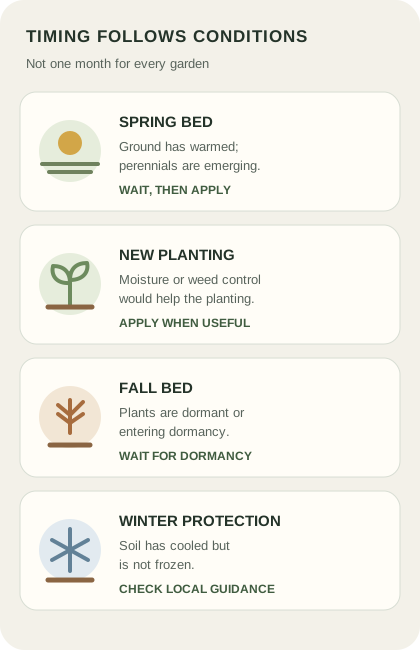
Use plant and soil cues instead of a fixed month. In spring, wait for warmer ground and emerging perennials. For a new planting, add mulch when it will help with moisture or weeds. In fall, wait until plants are going dormant; winter-protection timing depends on local conditions.
The quick timing guide
- Spring beds: wait until the soil has warmed and perennials are emerging.
- New plants: mulch when moisture retention or weed suppression is useful; the soil should be moist and not frozen.
- Fall beds: wait until plants are dormant. For winter protection, follow local guidance on applying after the soil cools and before it freezes.
Choose the cue that matches your job
| Situation | Look for | Timing choice |
|---|---|---|
| An established spring bed | Soil has warmed and perennial growth is emerging. | Apply after the ground warms and plants begin to emerge. Mulching too early can slow emergence. |
| A new planting | The new plants would benefit from moisture retention or weed suppression. | Mulch after planting when that benefit is useful. Work over moist, non-frozen soil and keep material away from stems. |
| A regular fall bed | Plants are entering dormancy or have gone dormant. | Wait until dormancy rather than applying too early; early mulch can delay dormancy and increase cold-injury risk. |
| Winter protection | Your local guidance calls for a protective winter layer and the soil has cooled but is not frozen. | Use the local timing recommendation. Mississippi State Extension describes applying after soil cools and before it freezes for its regional guidance. |
Why a month is a weak rule
“Spring” and “fall” arrive at different times in different places. Extension sources also describe different jobs: waiting for perennial emergence, mulching a new planting, or protecting a bed through winter. A date that fits one location or purpose may be too early or too late for another.
Use the visible condition first, then check guidance from an extension service for your region and plant type. The sources below describe timing; they do not choose a mulch material or a finished layer depth for every bed.
After choosing a time, plan the amount
- Measure the bed rather than estimating area from a photo.
- Inspect any existing layer and decide whether it is suitable to keep.
- Choose a target depth from guidance for your material and planting, then calculate only the additional volume.
Check finished depth and calculate a top-up when mulch is already in the bed, or open the mulch calculator for measured areas, depth, bag size, and supplier units. Neither calculator selects the timing or depth for your plants.
Sources
- Iowa State University Extension: Using Mulch in the Garden — spring soil warming and perennial emergence; late-fall timing after dormancy; risks of applying too early.
- Royal Horticultural Society: Mulch — new-planting use, moist and non-frozen soil, and keeping mulch away from plant stems.
- Mississippi State University Extension: Mulches for the Landscape — regional spring timing after soil warms and winter-protection timing after soil cools but before it freezes.
Sources checked November 3, 2026. Timing varies with location, plant, and purpose. Follow current local guidance where it differs.