Mulch coverage calculator
Calculate quantities for rectangles, circles, multiple areas, and mixed units.
Mulch calculator / Mulch coverage per bag
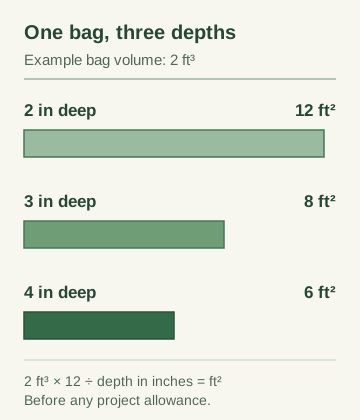
Bag coverage by depth
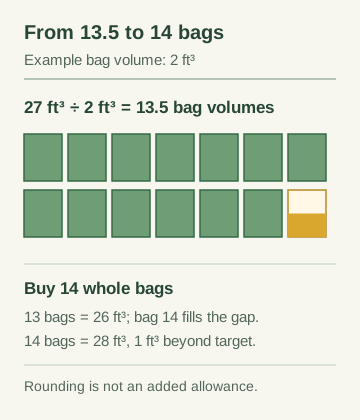
Need at least one cubic yard (27 ft³)? Use 14 whole 2-ft³ bags (13.5 rounds up) or 9 whole 3-ft³ bags. See the full bag-size table.
One 2-cubic-foot bag covers 8 square feet at 3 inches deep. At 2 inches it covers 12 square feet; at 4 inches, 6 square feet. All figures assume a uniform layer before allowance.
Read your bag’s printed volume and compare depths below. For a measured bed, calculate whole bags.
Compare the volume printed on your bag at your chosen depth.
| Depth | 1.5 ft³ bag | 2 ft³ bag | 3 ft³ bag |
|---|---|---|---|
| 1 inch | 18 sq ft | 24 sq ft | 36 sq ft |
| 2 inches | 9 sq ft | 12 sq ft | 18 sq ft |
| 3 inches | 6 sq ft | 8 sq ft | 12 sq ft |
| 4 inches | 4.5 sq ft | 6 sq ft | 9 sq ft |
For a uniform layer, square feet per bag = bag volume in cubic feet × 12 ÷ depth in inches. The volumes below are calculation examples; use the exact volume printed on your package. If your package gives coverage area at a stated depth instead of cubic volume, use the mulch bag coverage calculator to convert that label basis for your measured beds.
Planning note: Coverage is a volume calculation, not a depth recommendation or supplier quote. Check the package label and use the depth appropriate for your project.
These are arithmetic estimates at a uniform depth, not a product catalog. For a measured project, enter your area and bag size in the mulch calculator. The area × depth and bag-volume method is described by Iowa State University Extension.
One cubic yard = 27 cubic feet
| Bag volume | Calculation | Whole bags |
|---|---|---|
| 0.5 ft³ | 27 ÷ 0.5 = 54 | 54 bags |
| 1 ft³ | 27 ÷ 1 = 27 | 27 bags |
| 1.5 ft³ | 27 ÷ 1.5 = 18 | 18 bags |
| 2 ft³ | 27 ÷ 2 = 13.5 | 14 bags |
| 2.5 ft³ | 27 ÷ 2.5 = 10.8 | 11 bags |
| 3 ft³ | 27 ÷ 3 = 9 | 9 bags |
Formula: whole bags = ceiling(27 ÷ bag volume in cubic feet). A partial bag cannot cover a full cubic yard, so the result is rounded up.
Metric package reference
| Printed bag volume | 1 cubic yard (764.555 L) | 1 cubic meter (1,000 L) |
|---|---|---|
| 40 L | 20 bags | 25 bags |
| 42.5 L | 18 bags | 24 bags |
| 50 L | 16 bags | 20 bags |
| 60 L | 13 bags | 17 bags |
Formula: whole bags = ceiling(reference volume in liters ÷ printed liters per bag). One cubic yard is 764.555 liters when rounded to three decimals, calculated from 27 cubic feet and NIST's exact international-foot conversion (1 ft = 0.3048 m; NIST conversion factors).
Use the package volume printed for the exact product; a product name does not guarantee one standard bag size. For a measured project, enter the bag size in the mulch calculator, or calculate mulch litres and whole metric bags. If material remains in the bed, first calculate the new layer with the mulch top-up calculator.
Common questions
Yes. A cubic yard is a volume unit equal to 3 ft × 3 ft × 3 ft, or 27 cubic feet.
At a uniform 3-inch layer, one cubic yard (27 cubic feet) covers 108 square feet before project allowances. For other depths, see the cubic-yard coverage chart.
One cubic yard is 27 cubic feet. 27 ÷ 2 = 13.5, and a partial bag cannot be purchased as a complete bag, so the count rounds up to 14.
Only if your site conditions or supplier guidance call for an allowance. Keep the measured quantity separate from any extra amount so the basis stays clear.
Coverage depends on depth. One 2-cubic-foot bag covers about 12 square feet at 2 inches deep, 8 square feet at 3 inches, or 6 square feet at 4 inches before any project allowance.
Use the cubic-foot or liter volume printed on the exact package. The sizes in this chart are calculation examples, not a complete product list.
Related mulch tools
Calculate quantities for rectangles, circles, multiple areas, and mixed units.
Enter local material, delivery, and labor rates for a per-area estimate.
Turn measured areas into an order quantity and installation checklist.
See the volume and bag formulas with worked examples.
Subtract existing mulch before converting the new volume into bags.
Use an editable coverage per bale for fresh beds, refreshes and tree rings.