Wood moisture and weight
The USDA Forest Products Laboratory's Wood Handbook states that wood weight and other properties depend on moisture content. This source supports the wood-moisture boundary; it does not supply a universal mulch-bag weight.
About 25 to 50 lb per 2 cu ft bag is the reported range for the five products below.
40 matching 2 cu ft bags: roughly 1,000 to 2,000 lb across the cited product range (40 × 25 lb to 40 × 50 lb). Check the exact label, or weigh one complete matching bag for hauling.
No single weight applies to every mulch bag. These references mix a manufacturer-listed weight, an approximate manufacturer weight and dated customer-service estimates, not five package net weights.
Sources checked September 28, 2026. The two 2018 answers are historical estimates, not current guarantees. Preen describes its product as packaged/sold by volume, not by weight.
Do not average these figures or use them to clear a vehicle load.
Use a weight for the bags you are buying, not an average from the list. For a pickup split, weigh one complete matching bag and enter your vehicle's remaining payload.
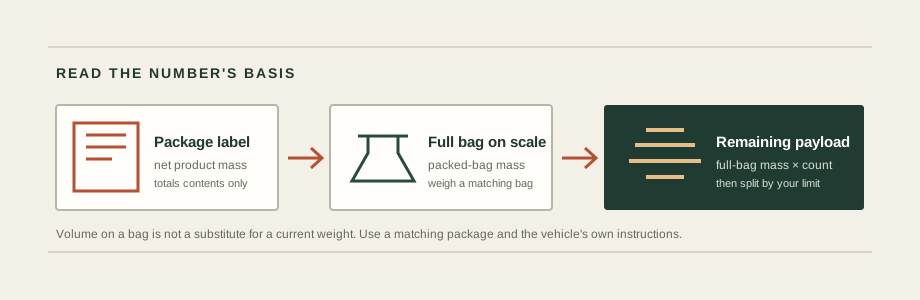
A volume such as cubic feet describes how much room the bag's contents occupy. It is not a weight. Mulch materials are not interchangeable by mass, and wood-based mulch can gain or lose water; the USDA Forest Products Laboratory explains that wood weight depends on moisture content. This tool therefore has no preset for a “typical” bag.
Choose the package-label option when you want the total product mass from the stated net weight. Choose the scale option when planning a haul: weigh one unopened bag from the same order as it will be carried, then enter only the payload remaining for those bags. In the United States, NHTSA describes the vehicle placard capacity weight as the combined weight of occupants and cargo; follow the instructions and ratings for your own vehicle, trailer and location.
The calculated trip split is only division using the values you supply. It cannot confirm that a vehicle, axle, trailer, load distribution or tie-down arrangement is safe.
The USDA Forest Products Laboratory's Wood Handbook states that wood weight and other properties depend on moisture content. This source supports the wood-moisture boundary; it does not supply a universal mulch-bag weight.
For US vehicles covered by the cited interpretation, the capacity placard's stated limit combines occupants and cargo. The remaining amount depends on the actual people and other cargo in the vehicle.
When a US package declares weight or mass under the cited rule, the declaration is for net contents. That does not turn a volume-only mulch label into a weight measurement. NIST distinguishes net contents after tare deductions from gross package weight, which includes the contents and packing materials. This calculator keeps a package label and a full-bag scale reading separate.
eCFR · 16 CFR § 500.9 · NIST Handbook 133 (2026), Appendix F
The five 2 cu ft products referenced here have reported bag weights of about 25 to 50 lb. This is a product-specific reference range, not a universal bag weight or five label net weights. For your order, use its stated net product weight or weigh one complete matching bag. Wood moisture and product differences can change the weight.
Using the reported 25 to 50 lb range for the five cited 2 cu ft products, 40 matching bags give a rough arithmetic range of about 1,000 to 2,000 lb (40 × 25 lb to 40 × 50 lb). The source weights are product-specific, not a universal bag weight. For an exact order, use the package's net weight; for hauling, weigh a complete matching bag.
No. Package volume describes space, while weight is a separate measurement. Use the weight shown for the exact product or a matching full-bag scale reading; this page will not infer weight from bag volume.
The label basis calculates net product mass only. For a load split, choose the full-bag scale basis, weigh a matching bag as carried, and enter the remaining payload from your vehicle or trailer instructions. The result is arithmetic only, not a safe-load clearance.
When you provide the measured weight of a complete bag and the remaining payload available for mulch, the calculator divides remaining payload by packed-bag weight, rounds down to whole bags per trip, and divides your order into the arithmetic number of trips. It does not verify vehicle ratings or loading safety.
Estimate area, depth and whole bags in the mulch bag coverage calculator. For a bulk order measured in cubic yards, use the mulch load calculator with the supplier's current weight per cubic yard.
Need somewhere to keep the filled bags before spreading? Compare their measured outer footprint with your available rectangle in the bag storage space calculator. Bag quantity, pickup weight and staging space are separate checks.