Start with the cap
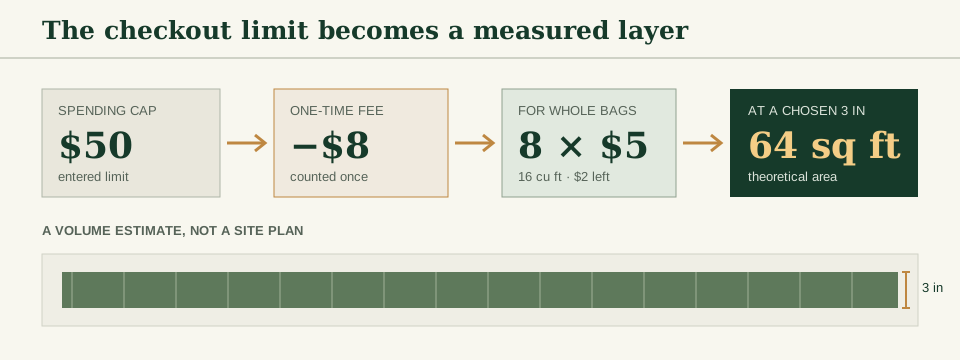
The example has $50 available and one $8 fixed fee, leaving $42 for bags.
Mulch calculator A fixed-spend bag estimate
Start with the most you can spend. Enter one bag quote and the depth you choose to see how many whole bags fit and the theoretical area their volume covers.
This calculator reverses the usual shopping question. Instead of asking what a measured bed will cost, start with a spending cap and a quoted bag price. The calculation reserves one entered fixed fee, buys only complete bags with the remainder, then converts their labeled volume into a theoretical area at the depth you selected.
The volume relationship follows the same area × depth method used to estimate material for a measured bed. Rearranging it gives area = volume × 12 ÷ depth when volume is in cubic feet and depth is in inches. See Iowa State University Extension’s mulch quantity guide. Formula checked October 6, 2026.
The example has $50 available and one $8 fixed fee, leaving $42 for bags.
At $5 per 2-cu-ft bag, $42 buys 8 bags for $40; $2 remains after the $8 fee.
Eight bags contain 16 cu ft. At a chosen 3-inch layer, 16 × 12 ÷ 3 = 64 sq ft before an allowance.
These values demonstrate the arithmetic only. Replace them with a current quote; the calculator does not claim that these prices are typical or available near you.
The estimate covers one product, one price per bag, one bag volume and one fixed fee. It does not model tax, percentage fees, coupons, changing prices, volume discounts, stock limits, mixed products, waste, gaps, uneven ground, plant areas or settling. A lower spend does not establish that a product or depth is suitable for a particular bed.
If no whole bag fits after the fee, no order is assumed and the fee is not deducted. To test a delivery rule that changes with order size, compare the supplier’s actual terms in the bulk-versus-bags cost calculator.
Subtract the one-time fee from your budget, divide the remaining amount by the price per bag, and round down to a whole bag. If the first bag plus its fee exceeds the budget, no order fits.
It multiplies the whole bags by the cubic-foot volume you enter. In US units, theoretical square feet = cubic feet × 12 ÷ your chosen depth in inches. The result does not include uneven ground, gaps, spilling or an extra allowance.
No. If the budget cannot cover one whole bag plus the entered one-time fee, the calculator treats that as no order. It counts no fee as spent and leaves the full budget unspent.
No. Enter the bag price and any quoted one-time fee you want to model. Taxes, percentage fees, coupon eligibility, changing prices and volume discounts are not modeled.
This calculator starts with a spending cap and estimates bagged coverage. To compare measured project needs against entered bag and bulk offers, use the bulk-versus-bags cost calculator.