Mulch calculator / Removal, not replacement
Mulch Removal Cost
Published local hauling example
$300–$450 NYC · quarter truckload
A hauler's advertised tier (~4 cu yd), on a yard-waste page that includes old mulch. Not a national average or a confirmed bed-stripping quote.
Source page modified October 20, 2026 · price checked October 25, 2026. Weight and access can change the quote.
Your removal-only quote
— USD
Enter the four whole-job amounts from your written quote; nothing is pre-priced.
Disposal-only fees are not full removal quotes
These public examples apply to the named materials at the named facilities. They do not pay someone to lift mulch from your beds, load it or drive it there. Confirm acceptance and the current charge before hauling; a wood or green-waste category does not establish acceptance of rubber mulch.
Philadelphia · clean, separated wood chips
$45 / ton · $15 minimum
The city's organic recycling fee page lists this drop-off charge. Applicable sales tax is extra; contaminated or mixed material may be refused. Undated page, checked September 29, 2026. This is not the separate wood-chip purchase price.
Sacramento County · Kiefer Landfill
$115.65 / ton · $45 minimum weight charge
The fee table effective January 1, 2026 lists green waste and clean wood waste in this weighed category. Mixed loads and material restrictions can change the charge. It is not a car-load rate or a price per yard of garden bed.
Santa Cruz County · sorted wood / yard waste
$70 / ton · $22.50 minimum
The rate schedule effective July 1, 2026 lists this as a discounted rate, available only when market conditions support recycling. The County Director determines whether the discount applies with 30 days' advance notice; otherwise the refuse rate applies. Check the current schedule before hauling. Base rates apply to unincorporated county and Scotts Valley; Capitola, Santa Cruz, Watsonville and out-of-county loads have a 28% surcharge. Proof of residency and sorting restrictions apply.
Three different facilities, materials and fee schedules—not a low-to-high market range. No ton-to-yard conversion, national average or automatic worksheet price is calculated from them. Minimums are disposal minimums, not whole-job removal minimums.
A published price is only useful with its scope
A City of Cloverdale project document from 2019, Exhibit A lists $27,660 in machinery and labor to remove rubber chips at four parks and load city-supplied debris bins. A separate $31,340 line covers placing city-supplied replacement chips; the combined proposal is $59,000.
Historical municipal proposal, not a current homeowner quote or proof of final payment. Bins, park closure and replacement chips were outside that contractor's quoted scope. The document does not establish a per-yard removal rate, a garden-bed price or your disposal charge. Do not load these figures into the worksheet as defaults.
Tell the contractor how much layer you intend to lift
Keep quantity separate from pricing. Measure each section below; then ask the contractor to confirm the actual lift, access, pickup and disposal scope. The measured in-place volume is not a loose truckload or an automatically billable quantity.
In-place mulch to lift
—cu ft
— cu yd before the material is disturbed
Your first measured section
Your measurements will split this layer.
Enter the area and both measured depths for your first section. Nothing is assumed.
Measure each section
Use separate rows when beds have different existing depths. Leave depth is your decision, not a preset.
Section-by-section removal
Measured sections will appear here.
Measured area: —
Measure the layer that is actually there
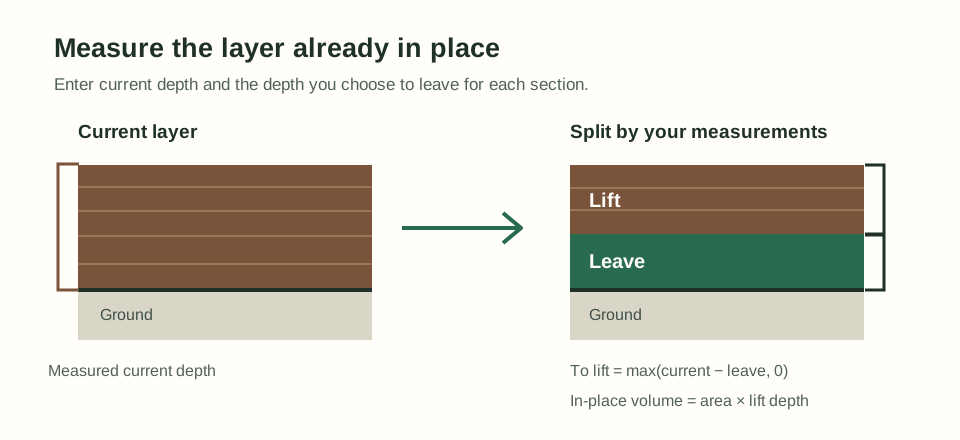
For each row, area is length × width or the square-foot area you measured independently. Depth to lift is the larger of current depth minus depth to leave, or zero. In-place cubic feet = area × depth to lift ÷ 12. Add the cubic feet of all rows; divide by 27 for cubic yards. No rounding, loose-volume factor or disposal allowance is added.
Iowa State University Extension documents the area × depth volume conversion. Applying it to an existing layer is this worksheet's arithmetic inference. University of Maryland Extension, updated March 14, 2023, describes problems caused by excessive mulch around trees and shrubs and notes that old material may be removed or used elsewhere. Its advice does not establish one safe depth for every bed or material.
Before you plan hauling
Measure several spots if the layer varies, then split them into rows. Do not use the in-place result as a loose load size: material texture, moisture and how it is loaded change that amount. Ask the local hauler or facility about what it accepts and how it quotes volume. This tool does not estimate weight, disposal fees or local rules.
If you actually need to add mulch over a usable existing layer, use the top-up calculator instead. Do not use the removal figure as an order for new material. For several beds, the mulch refresh calculator for multiple beds accounts for each existing depth and combines only the added volume into one bag or bulk order.
Keep the quote and the layer separate

When asking for a quote, describe which beds are included, the layer to leave, the access route and who supplies containers. Ask whether the written amount includes loading, travel, disposal and any minimum charge or tax. If the quote uses hourly or weight-based billing, obtain the agreed hours or weighed quantity and a whole-job amount before using the four cost fields.
Mulch removal questions
How much does old mulch removal cost?
One NYC hauler advertises $300–$450 for a quarter truckload (about 4 cubic yards) on a yard-waste page that includes old mulch. This is a local advertised tier, not a nationwide average or a confirmed price to strip your beds. Disposal-only fees are separate examples, not whole-job removal prices. Obtain a current written quote that confirms lifting, loading, access, hauling and disposal.
Is removing old mulch the same price as installing new mulch?
No. Keep the lifting and loading of existing material, its pickup and disposal, and the purchase and spreading of new material separate. A replacement-job total may include several of these tasks; do not treat that total as a removal-only price.
Does all the old mulch need to come out before adding new mulch?
Not automatically. University of Maryland Extension says organic mulch should be replenished only as needed and describes working decomposed material into a planting bed or other garden areas. Check the existing layer, plants and material in person. This calculator cannot decide whether it is suitable to keep or reuse.