Mulch calculator Convert yards and tons
BULK MULCH · SUPPLIER DENSITY
Mulch Yards to Tons Calculator
Cubic yards measure volume; tons measure weight. Enter the density on your supplier quote to convert either way. The density field starts blank, so the result never assumes how much your mulch weighs.
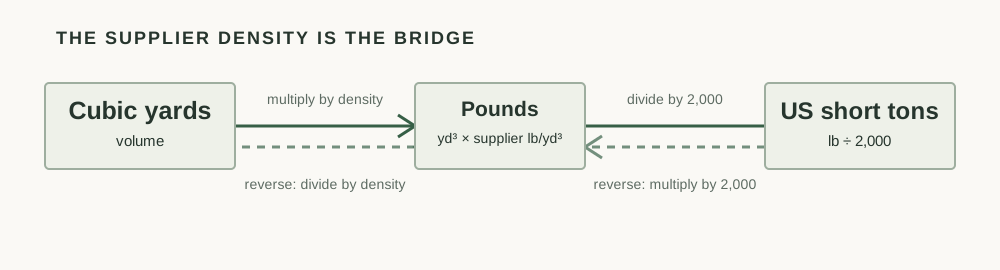
The conversion uses the density you enter
For volume to weight, multiply cubic yards by density in pounds per cubic yard, then divide pounds by 2,000. To reverse it, convert short tons to pounds and divide by the same density. If the source density is in pounds per cubic foot, the calculator multiplies it by 27 to express pounds per cubic yard.
Yards to short tons
yd³ × lb/yd³ ÷ 2,000 = US short tons
Short tons to yards
US short tons × 2,000 ÷ lb/yd³ = yd³
Density from lb/ft³
lb/ft³ × 27 = lb/yd³
NIST's 2026 Handbook 44, Appendix C lists 27 cubic feet per cubic yard and 2,000 pounds per US short ton. The page uses those unit definitions; the supplier density remains your input.
Match the density unit on the quote
Do not enter the same number under a different unit. These are equivalent ways to describe density; the calculator converts the selected unit before it calculates the order weight.
Those figures above are unit-equivalent arithmetic examples, not a typical mulch density. If the quote does not identify a density basis, ask the supplier what quantity and condition the number describes before comparing weight with volume.
A worked example with an explicit input
Suppose a quote lists 3 cubic yards and the supplier gives a density of 500 lb/yd³. The arithmetic is 3 × 500 = 1,500 lb, then 1,500 ÷ 2,000 = 0.75 US short tons. This example demonstrates the unit path only; 500 lb/yd³ is not presented as a mulch average.
If your quote instead lists short tons, use the other direction. At the same illustrative density, 0.75 short tons equals 1,500 lb; 1,500 ÷ 500 = 3 cubic yards.
Mulch yards and tons questions
How many tons are in one cubic yard of mulch?
There is no single conversion without the mulch density. Enter the value for the exact product from your supplier. For an illustration only, 3 cubic yards at 500 pounds per cubic yard equals 1,500 pounds, or 0.75 US short tons. The example density is not a typical mulch value.
What if my supplier gives density in pounds per cubic foot?
Choose lb per cubic foot in the density-unit list and enter the supplier's figure. The calculator multiplies that density by 27 because one cubic yard contains 27 cubic feet, then uses the normalized value in the conversion.
Does this calculator assume a mulch weight?
No. The density field starts blank. Use a current figure for the product and condition on your quote or specification; this page will not replace a missing density with a generic mulch value.
Is a US short ton the same as a metric tonne?
No. This calculator reports US short tons, which are 2,000 pounds. A metric tonne is 1,000 kilograms. Check which unit appears on your supplier's document before comparing quantities.
Can I use this result to confirm a safe pickup load?
No. The result is only an arithmetic weight estimate from the quantity and density you enter. It does not check a vehicle, trailer, axle, towing, loading, or securement limit.
Continue with the quantity you have
Only know the bed dimensions and target depth? Start with the mulch calculator to estimate volume. Planning pickup trips from a supplier's cubic-yard total? Use the mulch load calculator; it also compares the weight and usable-space limits you enter. Checking the quantities and arithmetic on a written quote? Open the mulch quote check calculator.