Single-rectangle cut planner / Multiple beds
Landscape Fabric Roll Planner for Multiple Beds
Measure each rectangular bed separately, enter one roll size and the overlap from its product instructions, then get a shared roll cut plan. Each bed keeps its own strip direction.
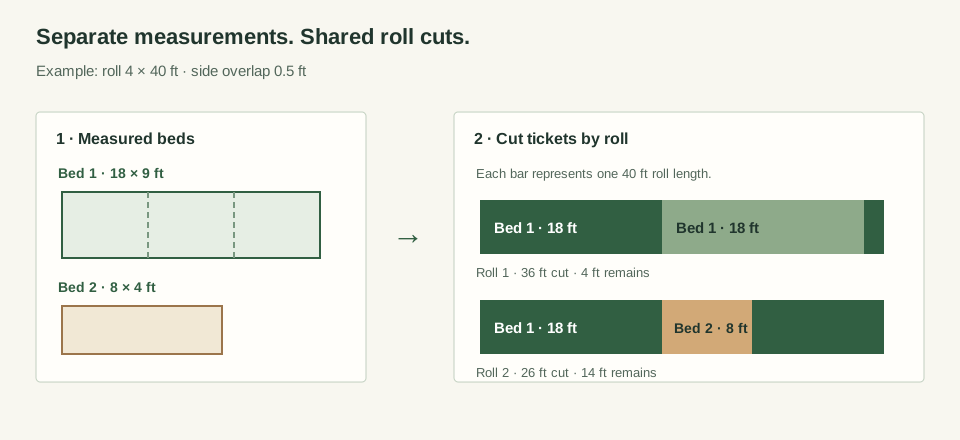
How the shared cut plan works
For each bed, the planner compares strips running along its length with strips running across its width. It counts the strips needed to cover the other dimension after your entered side overlap, then keeps each strip at full roll width.
After selecting a direction for each bed, the planner sorts the required strips from longest to shortest and places each cut on the first roll with enough uncut length. This gives a concrete cut ticket for each roll. It is a packing heuristic, not a proof of the fewest rolls.
Example with two beds
With a 4 × 40 ft roll and 0.5 ft side overlap, an 18 × 9 ft bed can use three 18 ft strips when the runs follow its length. An 8 × 4 ft bed needs one 8 ft strip in that direction. The shared tickets are two 18 ft cuts on roll 1 and one 18 ft cut plus one 8 ft cut on roll 2. The plan uses two rolls and leaves 4 ft and 14 ft uncut, respectively.
Use one roll size for all beds in a plan. For a single rectangle, see the single-area fabric cut planner. For fasteners, enter the product's stated rate in the landscape fabric staple calculator.
Questions about multi-bed fabric planning
What is different from a fabric area calculator?
This planner keeps up to eight measured rectangles separate, compares two strip directions for each one and combines their cut lengths on shared rolls. It does not turn the areas into one connected rectangle.
Does the cut plan use the fewest possible rolls?
It gives a feasible plan using a longest-strip-first packing pass. A different cut arrangement may use the same or fewer rolls, so the plan is not a guarantee of the global minimum.
What overlap should I enter?
Use the overlap stated for the exact fabric and installation you chose. The calculator has no default overlap and does not recommend one. Enter zero explicitly when your plan uses no side overlap.
Can a strip join two pieces when the roll is too short?
No. Each strip is kept continuous and must fit within the roll length. End joins and their overlap are not included.
Does this planner decide whether landscape fabric belongs under mulch?
No. It only plans quantities after you choose a product and application. Check the product instructions for suitability and installation details.